
Claude Code training for teams that want one workflow running by the end
This Claude Code training is for the lead of a technical, operations or content team who has been asked to put AI to work on real tasks. Most AI training ends with a certificate and a folder of prompts, so nothing changes the following Monday. Here your team builds one working workflow on your own systems during the engagement, and then they maintain it after we leave.
What changes when AI can act on your files
A chat window answers questions. By contrast, Claude Code reads your files, runs commands, calls your tools and follows procedures your team writes down, such as skills, agents, hooks and checks. Anthropic’s Claude Code documentation covers each of those parts in detail.
Once the tool can act, the hard questions move. Your team has to decide what it may do, how to check its work, and how to stop it from repeating a mistake. Those are the agency and scale questions in the Four Unlocks, Joe’s way of sorting out what holds an AI project back, and they take up most of the time in the sessions.
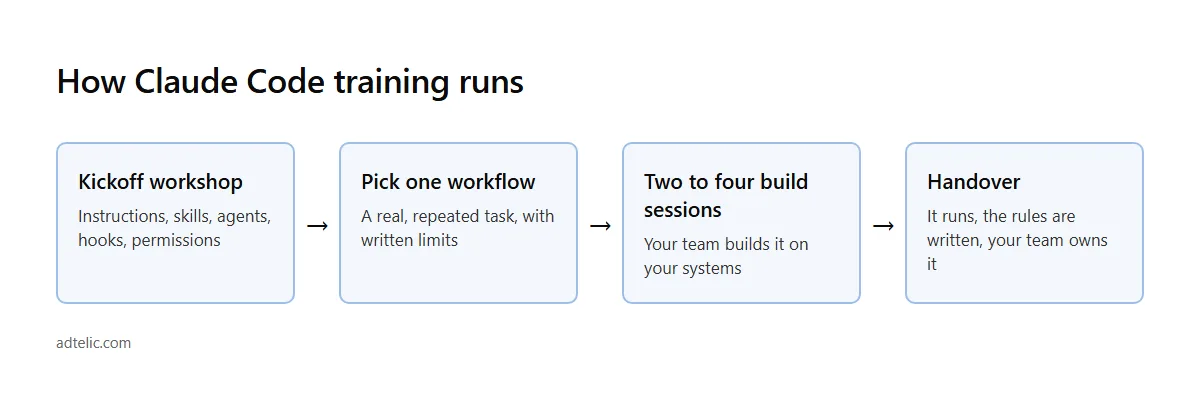
How the Claude Code training runs
- Kickoff workshop. First, your team learns the working parts on a sample task: project instructions, skills, agents, hooks and permissions.
- Pick one workflow. Together we choose a real task your team repeats, and then we write down what the agent may and may not do.
- Two to four working sessions. Your team builds it on your systems while we review it and add checks. We also push back when the agent has more permission than the task needs.
- Handover. After that, the workflow runs, its rules sit in a file anyone can read, and your team owns it.
We teach from the pipeline that runs our own sites
AdTelic’s content for belizenewspost.com and artdesignideas.com goes through a seven-stage pipeline built with Claude Code: planner, writer, humanizer, critic, linter, tester and publisher. Each stage is a separate agent with its own written rules. When a check fails, the linter or the tester stops the run. Even then, nothing goes live on its own, because every post lands as a draft for a human to approve.
So the examples in the room come from that system, including the parts that broke and the checks we added after they did.
Who should come, and when to hire someone else
The program suits teams of 3 to 12 people. You need at least one person who is comfortable at a command line, but everyone else can be a domain expert. It works for a platform team inside a large company and for a small business with two or three people who build.
We don’t build the workflow for you. If you want the build done for you, that is a separate project under AI implementation consulting. You can also compare all five AI training programs on one page.
Questions we get
Do we need developers?
One person comfortable with a terminal is enough, because the rest of the team writes the procedures. That is where most of the value is.
What about security and data access?
Permissions are part of the curriculum. We start with the least access the task needs and widen it only after a check proves it’s safe.
Is AdTelic affiliated with Anthropic?
No. AdTelic is an independent firm that builds with Claude Code every day.
How much does it cost?
It depends on team size and the number of working sessions, so we quote after the discovery call.
Book a 30-minute discovery call
Bring one task your team repeats every week. Then Joe will tell you whether it makes a good first workflow for Claude Code training.