AI training for mid-sized companies, starting with the people who decide
The board wants an AI plan from you. You also have a full-time job already. Most AI training for mid-sized companies skips that problem, because it teaches staff to write prompts before anyone has agreed what to do first.
A company your size is too big for the founder to just decide and too small for an AI team. Your IT lead is keeping the lights on, and your operations lead already has two jobs. Meanwhile, staff use AI tools on their own, with no shared idea of what is worth the effort.
How does AI training for mid-sized companies run here?
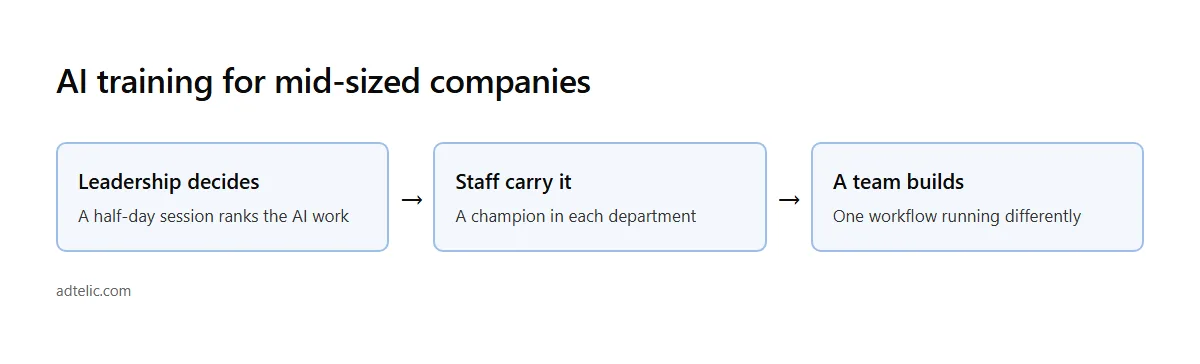
Most companies start with a leadership session. Then they train a few staff to run AI projects in their departments, and only then build anything. Each step is its own program, so you can stop after any of them.
First, leadership decides
The Executive AI Session for your leadership team takes four hours, on-site or on Zoom. The room holds 8 to 20 people. Before it, we collect the AI initiatives and vendor pitches already in play. Then the team goes through each one together and leaves with a ranked list and a name against every item. You get a written summary within 48 hours.
The team asks four plain questions of each item, which we call the Four Unlocks. Context asks whether the system can see the documents and data the task needs. Agency asks whether it can act or only suggest. Scale asks whether you know its error rate on your work, and who watches it. Workflow Redesign asks whether the process around it would change if this step became free. We plan the agenda long, because real discussion runs slower than any desk estimate, and we skip breakout rooms.
Then staff carry the list
Next, one or two people per department join the AI Champions Program for staff. Your leadership team nominates 10 to 25 people, and they meet weekly on Zoom. Each champion brings one task from their own team. By the end, every department has someone with a scoped use case, tested against the same four questions.
After that, a small team builds
The people who will build take Claude Code training for your team. It starts with a kickoff workshop, then two to four working sessions on your own systems. By the end, they ship one real workflow and know how to maintain it. If a fix needs more engineering than that, we scope AI implementation separately.
However, many companies stop after the first or second step, and that is fine. We write the summary so your own team can carry it out without us.
What is different the week after?
Mid-sized firms already use AI, but few have it in their core processes. In RSM’s 2026 middle market AI survey, 86% of executives said AI is part of their operations. Only 36% said it is deeply woven into core processes. So the gap is rarely access to tools.
- Your leadership agenda asks which of the four questions holds an AI item back, instead of which tool to buy.
- Each department has a named person who can judge a new AI idea.
- At least one workflow runs differently because of AI, and someone owns it.
Where have we done this, and when are we the wrong call?
In October 2026 we delivered a four-hour session for a 16-person leadership team at a global industrial manufacturer. A multi-week champions program with staff at the same company is under way now.
AdTelic sells no AI software, so if you need a platform or licences, call a vendor instead. AdTelic is Joe Post, and the person on the discovery call is the person who runs your session. If your company sits inside a larger group, the page on enterprise AI training by division fits better. For a team of a few people, see AI training for small business. Member organizations should read AI training for associations. All five programs are on the AI training programs page.
Book a 30-minute discovery call.
Tell us who would be in the room and what is already on the table. Then we will tell you whether a leadership session is the right first step.